Showing posts with label Tour Auto. Show all posts

Sunday, 15 November 2020

1955 Pichon-Parat Dolomites


A 1955 Pichon Parat Dolomites on the 2020 Tour Auto.  

For more photos of the 2020 Tour Auto - click here.

Pichon et Parat Carrossier, Sens, L'Yonne, France.  Pichon-Parat were coachbuilders who started in 1952.  The company was named after the founders, Bernard Pichon and André Parat. The Dolomites was first presented at the Paris Motor Show in October 1953.  It was built on the base of a Panhard Dyna X, a small capacity, lightweight, front engine, front wheel drive saloon car.  By adding a lightweight streamlined metal body Pichon-Parat turned it into a desirable sports car for rallying.  With a weight of about 500kg and a 750cc 2 cylinder motor it could reach about 150 kph.  Versions were also offered up to 850cc.

One of the first cars was bought by Laurent Sagnier who entered it into the 1954 Tour de France Automobile and hence its eligibility for the modern Tour Auto.  About three different styles of the Dolomites were built, all for competition.  Nowadays, these cars are rather rare as only about twenty or so were ever made.  Pichon-Parat also made cars based on the Renault 4CV, Citroens, Lancias, Talbots, BMW and even American chassis; all in relatively small volumes.  Pichon-Parat continued into the early seventies as a coachbuilder although André Parat died in the mid-Sixties.


Friday, 5 May 2017

1952 Jaguar XK120 Roadster

1952 Jaguar XK120, Peter Terrell/Michael Holland, 2017 Tour Auto.
Pour plus de photos du Tour Auto 2017, suivez ce lien.

For more photos of the 2017 Tour Auto, click on this link.

Jaguar Cars, Coventry, England.   The XK120 was introduced in 1948 and produced until 1954.  It was the first car to be powered by the famous 3.4 litre XK straight six engine and was called the 120 because it was capable of over 120mph which made it the fasted production sports car at that time.  The 0-60mph time was around 10 seconds.  There were three versions including the open roadster seen here, a drop head convertible and a closed coupé version.  Early cars were aluminium bodied but later cars were steel.   The XK120 was extensively raced and rallied and achieved much success.  Victories included the 1950 Tourist trophy, the 1950 & 1951 Alpine rally, In the Tour de France Automobile one finished fifth in 1951.

Thursday, 4 May 2017

1960 DB HBR5

1960 DB HBR5, Antoine Laureau and Antoine Moreau, 2017 Tour Auto Optic 2000
Pour plus photos du Tour Auto 2017, suivez ce lien.

For more pictures from the 2017 Tour Auto, click on this link.

DB, Champigny sur Marne, France.  Founded by Charles Deutsch and René Bonnet, this small French manufacturer produced small racing cars and sports cars from 1947 to 1961.  One of their most successful model in terms of sales was the HBR5 which was sold between 1955 and 1961. As with many of their cars it featured a two cylinder Panhard engine.  The one pictured above has a 851cc engine but others had 748cc engines or 954cc engines and some were supercharged.  It had a fibre glass coupé body, was front engined and front wheel drive.  They were entered in many long distance events such as Le Mans 24 hours and the Tour de France Automobile having sucess in the Index of Performance competition.  The car was sometimes called the DB Coach and smaller engined versions were designated HBR4.

Wednesday, 3 May 2017

1949 Hotchkiss 864 Artois S49

1949 Hotchkiss 864 Artois S49, Tour Auto 2017
Pour plus de photo du Tour Auto 2017, suivez ce lien.

For more photos from the 2017 Tour Auto Optic 2000, click on this link.

Hotchkiss et cie, Saint Denis, Paris, France.  Hotchkiss was  originally an arms and munitions manufacturer founded by an American ordnance engineer called Benjamin Hotchkiss. After he died, the company produced car parts, car engines and then eventually whole cars.  The 864 Artois was based on a pre-war model and was sold in the late forties and early fifties.  It was a 4 door sedan with  a 2.3 litres 4 cylinder front mounted engine and rear wheel drive.  Top speed was around 75 mph.  As a sporting marque Hotchkiss won the Monte Carlo Rally a number of times in the early thirties. They also raced at Brooklands and Montlhery.  After the war they again competed in the Monte Carlo (winning in 1949 and 1950) and the Tour de France Automobile.  Eventually the marque was swallowed up by Delahaye.   In 2017 Maxime Lepissier and Bruno de la Villesbrunne drove this car in the regularity section of the Tour Auto Optic 2000.

Saturday, 31 December 2016

1965 Ford Mustang 289

Christian Odin, 1965 Ford Mustang 289, Tour Auto, 1st  Special Stage 2016.
Pour plus de photos du Tour Auto 2016, suivez ce lien.

For more photos of the 2016 Tour Auto, follow this link.

Ford, Dearborn, USA.  The first Mustangs appeared in 1964, even if they were referred to as 1965 models and were either 2 door hardtops or convertibles.  Driver train components were from the Ford Galaxy but the car was designed to have universal appeal, including to women, with bucket seats, room for 4 people and a $2,500 price tag.  The basic model had a low power 2.8 litre 6 cylinder engine but the 289 had a 4.7 litre V8 with better performance.  Top speed for the 289 was a little under120 mph and it had a 0-60mph time of a little over 8 seconds.   It was immediately a successful car with huge sales for Ford and the term "Pony Car" was created for it and its imitators.  The Mustang made its public debut as the pace car at the Indy 500 in 1964 and a convertible appeared in the film Goldfinger.  They were immediately raced and rallied worldwide.  In 1964 the Alan Mann entered Mustang 289 won its class and finished eighth overall in the Tour de France Auto driven by Peter Procter and Andrew Cowan.  The Mustang emblem on the front of the car has become a true automotive icon.

Wednesday, 25 May 2016

De Tomaso Pantera Grp IV Tipo 874A

Norbert and Claire Fradin, DeTomaso Pantera GrpIV, Tour Auto 2014, Chablis.
Pour plus de photos du Tour Auto 2014, suivez ce lien.

For more photos of the 2014 Tour Auto, click on the link above.

De Tomaso, Modena, Italy.   The Pantera, which is Italian for Panther, was an Italian mid-engined sports car powered by an American Ford V8 engine and was produced between 1971 and 1992.  Over 7,000 were produced. In the early seventies fourteen lightweight cars with 5.8 litre engines were built to contest Group 4 races.  With the uprated 500bhp engines they were good for 180mph compared to 160 mph for the standard version.  They were drivers by drivers such as Clay Regazzoni, Mario Casoni, Herby Muller, Mike Parkes and Jean Vinatier in endurance and sprint races all over the World.  Muller, Parkes and Regazzoni all won European GT Championship rounds in them.  Vinatier came sixth in the Tour de France Automobile in 1973.

Tuesday, 24 May 2016

BMW 3.0 CSL

Jean-Claude Basso, BMW 3.0CSL, Tour Auto 2014
Pour plus de photos du Tour Auto 2014, suivez ce lien.

For more photos of the 2014 Tour Auto, click on the link above.

BMW, Munich, Germany.  In 1972 BMW homologated the 3.0CSL for Group 2 racing.  In 1973 Toine Hezemans won the European Touring Car Championship in one and also took a class win in the Le Mans 24 hours co-driven with Dieter Quester.  Chris Amon, Jacky Ickx, Hans-Joachim Stuck, Niki Lauda, Brian Redman and Ronnie Petersen also drove them.  From 1975 to 1979 the BMW 3.0CSL repeated its European Touring Car Championship win.

Sunday, 22 May 2016

1961 BMW 700S

1961 BMW 700S, Tour Auto 2014
Pour plus de photos du Tour Auto 2014, suivez ce lien.

For more photos of the 2014 Tour Auto, click on the link above.

BMW, Munich, Germany.  The 700 was produced from 1959 to 1965 and had a rear engine of 700cc. Hans Stuck won the 1960 German Hillclimb Championship for Touring Cars  in a BMW 700.  Jacky Ickx also drove one after transferring from Motorcycles.  They competed in the Tour de France Automobile in 1961 and 1962.

Saturday, 21 May 2016

1955 Mercedes 300 SL Gullwing

1955 Mercedes 300 SL Gullwing, Tour Auto 2014
Pour plus de photos du Tour Auto 2014, suivez ce lien.

For more photos of the 2014 Tour Auto, click on the link above.

Mercedes-Benz, Stuttgart, Germany.   The racing car (W194) was introduced in 1952 and the production version (W198) from 1954 to 1963.    It was famous for its gullwing doors that opened upwards and had a 3 litre straight six engine.  The W194 won the Le Mans 24 hours and the Carrera Panamericana in 1952, and came second in the Mille Miglia.  The W198 won the European Rally Championship in 1955.  Top speed of the road version was around 150mph depending on axle ratios.


Friday, 20 May 2016

1951 Ferrari 212 Export Touring Berlinetta

Martin Halusa, 1951 Ferrari 212 Export Touring Berlinetta, Tour Auto 2015, start of the first special stage.
Pour plus de photos du Tour Auto 2015, suivez ce lien.

For more photos of the 2015 Tour Auto, click on thevlink above.

Ferreri, Maranello, Italy.  This car was introduced in 1951 and followed on from Ferrari's first production car, the 166MM and its evolution into the 195S.  It had a V12 2.6 litre engine and the body of this example was by Carrozzeria Touring of Milan whilst others were by Vignale of Turin.   The Chassis is generally referred to as the 212 Export, as Ferrari was eyeing the American export market.  The sporty coupé body style is known as a Berlinetta.  Although production cars, most of these were destined for racing by privateers.   The car with its 150bhp engine was good for 120mph and a0-60mph time of under 10 seconds.  One was entered in the 1952 Mille Miglia but didn't finish.   A Vignale bodied car won the 1951 Tour de France Automobile.   Another, bodied by Touring came sixth and won its class in the 1951 Tourist Trophy driven by Bobby Baird.

Tuesday, 17 May 2016

Opel Manta 400

An Opel Manta 400 warms up the crowd for the first stage of the Tour Auto 2016.
I assume the car above is a replica of one of the Rothmans Opel Rally Team Opel Manta 400s of the eighties.  In 1983 Henri Toivonen and Fred Gallagher won the Manx Rally in one, a European Championship round.  In the World Rally Championship they finished fourth in the San Remo Rally. Other drivers included Guy Frequelin, Ari Vatanen and Russell Brookes.   Jimmy McRae finished third in the 1983 RAC Rally whilst Rauno Aaltonen finished second in the 1984 Safari Rally.  Thus, rather overshadowed by some of its more famous Opel brothers of the time.  It was front engine and rear wheel drive.  The works versions had Cosworth tuned 2.4 litre engines.  0-60mph was under 5 seconds.

Monday, 16 May 2016

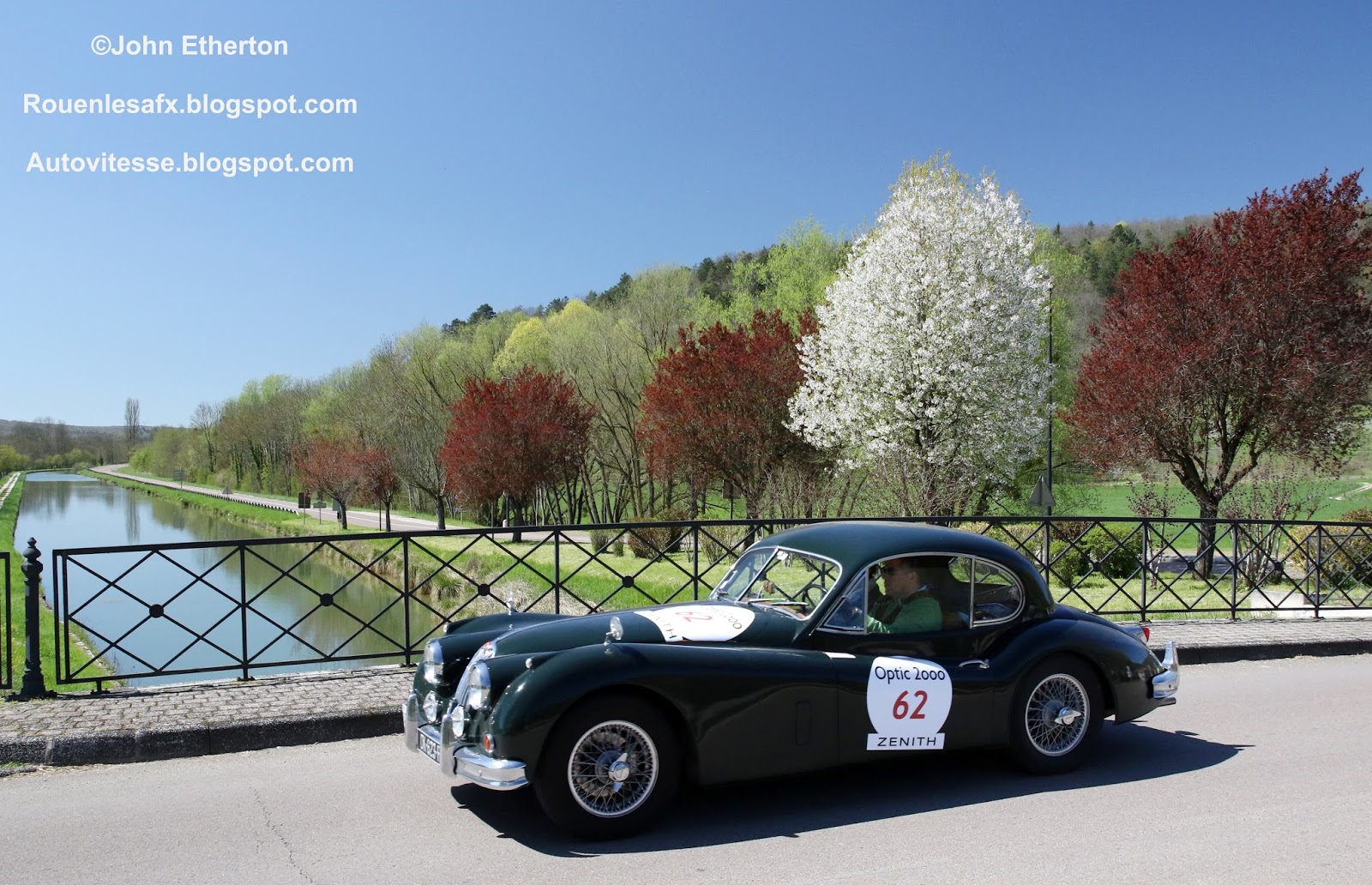
1955 Jaguar XK140 Fixed Head Coupé

 Eric Vandevelde and Bernard Dubois, 1955 Jaguar XK140 Fixed Head Coupe, Tour Auto 2016
Pour plus de photos du Tour Auto 2016, suivez ce lien.

For more photos of the 2016 Tour Auto, click on the link above.

Jaguar, Coventry, England.  The Jaguar XK140 was produced between 1954 and 1957 and was the model in between the XK120 and the XK150. Externally the XK140 was quite similar to the XK120. The Fixed Head Coupé was one of three body styles the others being the roadster and the drop head coupé. The two coupés had two small seats in the rear. All models were capable of over 120 mph and a 0-60 mph time of around 9 seconds.  There was a basic model and a slightly higher performance SE (Special Equipment) model that could achieve nearly 130 mph.  All models were powered by 3.4 litre XK straight six engine that achieve Le Mans wins in the C Type.  The XK140 FHC took second place in the 1956 RAC Rally driven by Ian Appleyard.

For information and a picture of the Jaguar XK140 Roadster, click here.

Sunday, 15 May 2016

1956 Austin Healey 100/4

Sébastien Berchon and Georges Plumet, 1956 Austin Healey 100/4, Tour Auto 2016.
Pour plus de photos du Tour Auto 2016, suivez ce lien.

For more photos of the 2016 Tour Auto, click on the link above.

Austin Healey, ,England.  This Austin Healey was built at Jensen's West Bromwich works and then finished at Austin's Longbidge plant.  The 2 seater roadster design was by Donald Healey who had originally planned to build it himself.  The 100 was named because it could achieve 100mph and the /4 indicated it had 4 cylinders as opposed to the six cylinders of the /6.   Originally built for the 1952 Motor Show, the 100/4 was produced commercially between 1953 and 1956.  The 100/4 had a 4 cylinder 2.7 litre engine.  The car used many mechanical parts from the Austin A90.  There were a couple of versions of the 100/4, the BN1, the BN2 and the ill fated 100S that was involved in the 1955 Le Mans disaster.


Saturday, 14 May 2016

1961 Alfa Romeo Giulietta Sprint Speciale 101.20 (Second Series)

Patrice and Maxime Cornille, Alfa Romeo Giulietta SS, Tour Auto 2016
Pour plus de photos du Tour Auto 2016, suivez ce lien.

For more photos of the 2016 Tour Auto, click on the link above.

For more photo of Alfa Romeos click on this link.

Alfa Romeo, Milan, Italy.  The Giulietta SS was a top of the range 2 door, front engine, rear wheel drive, sports coupé first seen at the 1960 Geneva Motor Show and produced from then to 1964. It followed on from the prototype Sprint Speciale, the low nose version and the Zagato SZ.  It thus was a Second Series Sport Speciale and in fact the production version.  It had the 1.3 litre 101 series engine which powered it to over 120 mph. In 1963 the 1.6 litre Giulia was introduced and it eventually replaced the Giulietta.  Although it was the production version rather than the racing version, the Giulietta SS was seen in events such as the Targa Florio and the Tour de France Automobile.

Thursday, 12 May 2016

1959 Sunbeam Rapier Series III

Yo Ming Nelson Tang and Nigel Kat and 1959 Sunbeam Rapier, 2016 Tour Auto
Pour plus de photos du Tour Auto 2016, suivez ce lien.

For more photos of the 2016 Tour Auto, click on the link above.

Sunbeam, Ryton on Dunsmore, England.  Sunbeam produced the original Rapier from 1955 to 1967.  it was a two door Coupé although convertibles were also produced.  it went through a series of revisions in its life from Series I to V.  It preceded the Rootes Group other creations, the Hillman Minx and Singer Gazelle.  The fifties cars had a 1.5 litre straight four engine. For later versions the capacity was increased to 1.6 litres.  The early series cars were capable of 90mph and a 0-60mph time of around 20 seconds.  Later versions could get from 0-60mph in just over 14 seconds.  In 1958 a Sunbeam rapier won the RAC Rally in very severe weather conditions crewed by Peter Harper and Bill Deane.  Harper also came fifth in that years Monte Carlo Rally driving a Rapier.  In 1962 A Sunbeam Rapier driven by Keith Ballisat and Ian Lewis came sixth in the Touring Car category and Rosemary Smith and Rosemary Seers won the Coupe des Dames in the same event.  Rapiers also competed and finished the last two Mille Miglia of 1956 and 1957.  I believe the car pictured is an ex-work Series III Rapier that competed in the 1960 Monte Carlo Rally driven by Peter Jopp and Les Leston.  In private hands it finished 2nd in the Welsh rally and then won some Motoring News events.

Wednesday, 11 May 2016

1953 Sunbeam Alpine

Jonathan and Christine Miles, 1953 Sunbeam Alpine, Tour Auto 2016
Pour plus de photos du Tour Auto 2016, suivez ce lien.

For more photos of the 2016 Tour Auto, click on the link above.

Sunbeam, Rootes Group, Ryton on Dunsmore, England. Over 1,500 Sunbeam Alpine were built between 1953 and 1955. A 2 seat roadster, it was a development of the Sunbeam-Talbot 90 saloon car, initially conceived by a Bournemouth Sunbeam-Talbot dealer.  The engine was a 2.3 litre straight four engine from the saloon and the steel body was handmade by Thrupp and Maberley coachbuilders.   Sales were focussed on North America. Top speed of the production car was around 90mph and 0-60mph close to 19 seconds.  In a tuned works car Stirling Moss achieved nearly 120mph.  There was a MkI and later a MkIII but no MkII curiously. The six works cars entered just two events, the 1953 and 1954 Alpine Rallies.  In the 1953 event four of the Sunbeam-Alpines were awarded Coupes des Alpes for unpenalised runs.  Stirling Moss won  Coupe des Alpes in the works car in both years.

Tuesday, 10 May 2016

1973 Jidé 1600

Jidé 1600,  Tour Auto 2015
Pour plus de photos du Tour Auto 2015, suivez ce lien.

For more photos of the road sections of the first day of the 2015 Tour Auto, click on the link above.

Jidé, Châtillon sur Thouet, France.  Founded by Jacques Durand, who also later founder Scora, this marque existed from 1969 to 1973. They made one Coupé, that was originally powered by a Gordini R8 engine.  They had polyester bodies and were sold as either kit cars or fully constructed. Intended as a smaller alternative to the A110, about 130 were produced.   Its most famous driver was Jean Ragnotti who drove one in the Criterium de Cévennes Rally in which he finished seventh..  In 1969 an early Jidé competed in the Tour de France Automobile but did not finish.  in 1973 a Jidé finished second in the Spanish Costa del Sol Rally. Wins came in a number of French National Rallies including the 1972 Rallye du Poitou and the 1973 Ronde Limousin when driven by Henri Rimaudière.  Nowadays, these cars are quite rare but are still regularly spotted in historic rally events.

Friday, 6 May 2016

1972 Chevrolet Corvette C3

A 1972 Chevrolet Corvette driven by Anthony Beltoise during the 2016 Tour Auto.
Pour plus de photos du Tour Auto 2016, suivez ce lien.

For more photos of the 2016 Tour Auto, click on the link above.

Chevrolet, St Louis , USA.  The Chevrolet Corvette is one of the most iconic of American cars and has been produced by General Motors from the fifties.  The C3 was the third generation of Corvette and was manufactured from 1968 to 1982.  Engine (a V8) and chassis were largely a carry over from the second generation but it benefitted from a new body and interior.   The body design was quite similar to the 1965 Mako Shark II concept car.  They were available as coupes as in the photo or as the less popular convertible model.  The car in the picture is painted in the stars and stripes similar to the John Greenwood 1971 Sebring car that finished seventh and won its class in the 12 hour race. However, the Tour Auto heritage is of the Greder Corvettes rather than the Greenwood Corvettes.  In the Tour de France Automobile of 1969 Henri Greder came second driving a Chevrolet Corvette and Marie-Claude Beaumont came fifth in a Greder Corvette in 1972.  The C3 in the early seventies was a successful car in racing and rallying and a classic shape that most of us admire.


Thursday, 5 May 2016

1963 Ferrari 250 GT Lusso

Eric Hamoniau, Ferrari 250 GT Lusso, Tour Auto 2016
Pour plus de photos du Tour Auto 2016, suivez ce lien.

For more photos of the 2016 Tour Auto, click on the link above.

Ferrari, Maranello, Italy.  Lusso means luxury in Italian and thus the 250 GT Lusso is a larger and more luxurious version of the Ferrari 250 GT Berlinetta.   It was not intended for racing but still some examples competed in the Tour de France (one finished 24th in 1964) and theTarga Florio (another finished 13th in 1964) in private hands.  It had a 0-60mph time of around 8 seconds and a top speed of around 150 mph.   Designed by Pininfarina, it had two seats, a steel Scaglietti body with some aluminium panels, and was powered by the 3 litre V12 engine similar to other 250s. Production was limited to 1963 and 1964.  A really beautiful car of which about 350 were made.

Wednesday, 4 May 2016

1965 Ferrari 275 GTB

Diego Ribadeneira, Ferrari 275GTB, Tour Auto 2016
Pour plus de photos du Tour Auto 2016, suivez ce lien.

For more photos of the 2016 Tour Auto, click on the link above.

Ferrari, Maranello, Italy.  The 275 GTB was a 2 seater front engined GT car produced by Ferrari from 1964 to 1968.  It had a 3.3 litre V12 engine and was the first Ferrari road car with fully independent suspension all round.   The one in the picture is a long nosed version as the earlier ones had too much front end aerodynamic lift.  Pininfarina designed the body and it was built by Scaglietti.  Some were steel bodied and some were aluminium bodied.  This was perhaps the last in the line of the classic fifties and sixties V12 front engined wire wheeled Ferraris as the Daytona was something else again.  It was a great road car but of course many were raced as well.  Top speed was around 160mph and it had a 0-60mph time of around 6 seconds.  An Ecurie Franchorchamps competition version came third overall in the 1965 Le Mans 24 hours and won its class driven by Mairesse and Beurlys.